 Add to Chrome
 Add to Firefox
 Add to Edge
UME: A Unified Meta-Generalization Framework for Cross-Domain ETA
May 31, 2026
Accurate Estimated Time of Arrival (ETA) prediction on checkout page is crucial in instant logistics for enhancing user satisfaction, optimizing dispatching, and controlling operational costs. In international on-demand delivery platforms, where ETA data originates from diverse countries or regions with different patterns, multi-domain modeling is of great importance and has been widely adopted. However, existing methods still face three critical challenges in real-world deployment. First, current multi-domain models struggle to generalize to completely unseen domains, failing to achieve zero-shot prediction during the initial cold-start phase. Second, cross-domain feature spaces are often assumed to be consistent, whereas new domains commonly suffer from structural missingness of offline (statistical) features due to the lack of historical data. Third, such feature missingness often compels industrial systems to model mature and cold-start domains separately, hindering knowledge transfer and increasing maintenance overhead. To address these challenges, we propose \textbf{UME}, a \textbf{U}nified \textbf{M}eta-generalization framework for \textbf{E}TA. Specifically, UME integrates a unified dual-branch architecture with a novel meta-learning mechanism that employs a hypernetwork-based meta learner. By leveraging domain-level knowledge and instance-level context, the meta learner empowers three meta modules to dynamically modulate feature gating, expert attention, and final prediction, capturing cross-domain correlations and facilitating intra-domain adaptation. A knowledge distillation strategy is further introduce to enhance performance. UME has now been deployed in Meituan-keeta delivery platform (the largest international food delivery platform in China). Extensive offline experiments and online A/B tests demonstrate that UME significantly outperforms existing baselines.

GCF: Generalized Causal Forest for Heterogeneous Treatment Effect Estimation in Online Marketplace
Mar 21, 2022

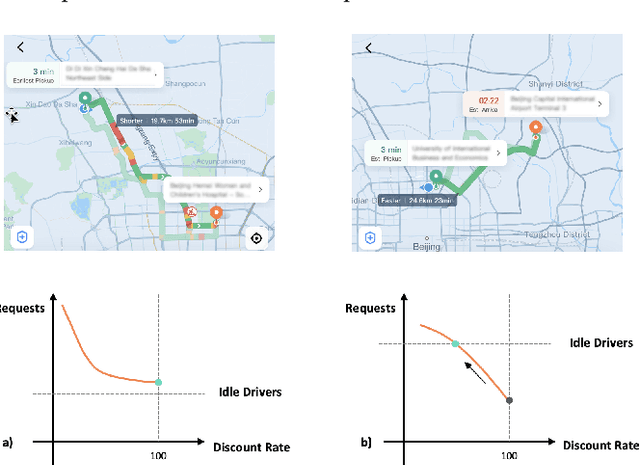
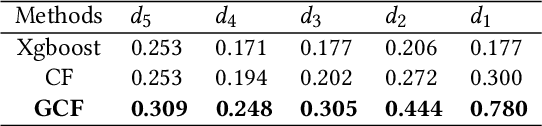
Uplift modeling is a rapidly growing approach that utilizes machine learning and causal inference methods to estimate the heterogeneous treatment effects. It has been widely adopted and applied to online marketplaces to assist large-scale decision-making in recent years. The existing popular methods, like forest-based modeling, either work only for discrete treatments or make partially linear or parametric assumptions that may suffer from model misspecification. To alleviate these problems, we extend causal forest (CF) with non-parametric dose-response functions (DRFs) that can be estimated locally using a kernel-based doubly robust estimator. Moreover, we propose a distance-based splitting criterion in the functional space of conditional DRFs to capture the heterogeneity for the continuous treatments. We call the proposed algorithm generalized causal forest (GCF) as it generalizes the use case of CF to a much broader setup. We show the effectiveness of GCF by comparing it to popular uplift modeling models on both synthetic and real-world datasets. We implement GCF in Spark and successfully deploy it into DiDi's real-time pricing system. Online A/B testing results further validate the superiority of GCF.